Keep colors consistent with palettes
Bind shared colors to swatches, then change a character or prop across drawings. Use local overrides for deliberate exceptions.
Share palette colors across artwork
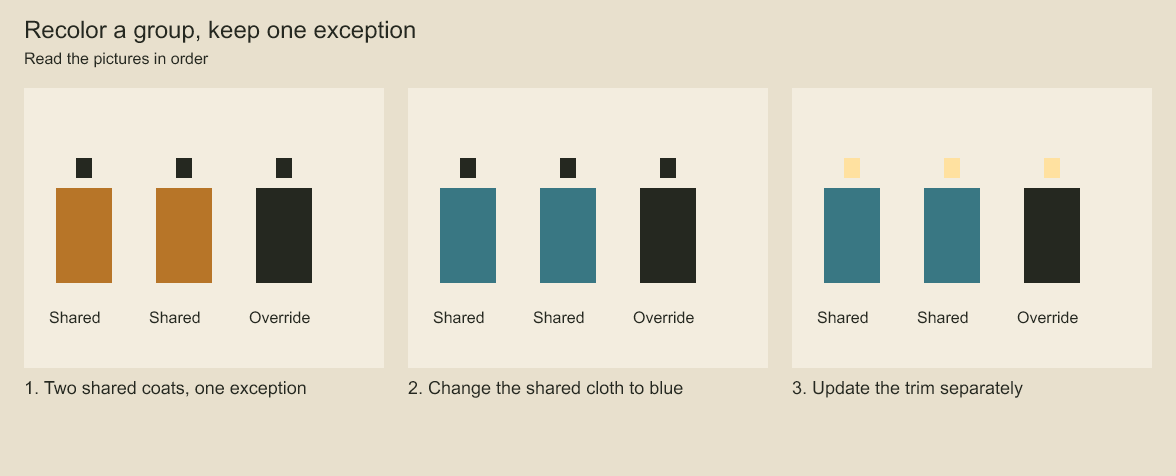
A bound element follows its swatch; a local override retains its own color.
Keep shared solid colors in a project palette and bind an element's color channel to a stable swatch ID. Palette and swatch IDs share the document's global ID namespace. putPalette replaces one palette and updates its bound colors in the same transaction, including board panels, component sources and shot animations.
const paint = panel.addVectorLayer('Paint');
const shirtId = paint.path(pathCommands('M100 100 L200 100 L200 200 L100 200 Z'), {
  fill: '#456789',
});
project.putPalette({
  id: 'palette:character', name: 'Character',
  swatches: [{ id: 'swatch:shirt', name: 'Shirt', color: '#456789' }],
});
project.setColorBinding(shirtId, 'fill', { swatchId: 'swatch:shirt' });

// An explicit local correction survives later swatch changes.
project.setColorBinding(shirtId, 'fill', {
  swatchId: 'swatch:shirt', override: '#28415c',
});
// Remove the override to follow the shared swatch again.
project.setColorBinding(shirtId, 'fill', { swatchId: 'swatch:shirt' });
// Detach the binding and keep the current literal color.
project.setColorBinding(shirtId, 'fill', null);
Supported channels are color for text and raster strokes, color/fill for vector strokes, and fill/stroke for vector paths. Binding a path fill explicitly replaces any gradient with the swatch's solid color. Pixel surfaces and individual gradient stops cannot be bound. These values use the existing drawing color pipeline; palettes do not add color-space conversion or external asset publishing.
Bindings belong to the artwork. Panel duplication, panel-to-shot capture and component cloning retain them; outlining a vector stroke maps its color binding to the resulting path's fill. Replacing an element is an explicit complete replacement: retain its colorBindings when the new artwork should keep following the palette. A bound literal must match its swatch or override; inconsistent edits reject. Removing a referenced swatch or palette rejects, including overridden references. Unbind or retarget those elements first. Any propagated edit touching another actor's locked artwork rolls back the whole transaction.
Use palettes({ limit, offset }) for summaries, paletteSwatches(id, { limit, offset }) for detached swatches, and production.element(id).colorBindings to inspect an element. Paged reads enforce the standard 200-record and 256 KiB limits. Each palette holds at most 1,000 swatches and 1 MiB of JSON. production.query and the saved object catalog expose palette and palette-swatch kinds.
Before revising a swatch, call project.paletteBindings(swatchId, { limit, offset }) to inspect its consumers without reading artwork payloads. Each record contains ownerKind (panel, component or animation), ownerId, layerId, elementId, channel, swatchId, and an optional local override. An override remains listed because it is still bound even when the effective color is unchanged by a swatch update. Missing swatches reject; an unused swatch returns an empty array. Reads default to 50 entries, cap at 200 and reject responses above 256 KiB. Ordering follows panels, components, then shot animations, with layer/element order and color/fill/stroke channel order inside each owner. Restart offset paging after edits; these pages do not have snapshot cursors.
Saved revision workflows use native palette.put, palette.bind (a binding or null), and palette.remove commands in project.plan/commit. Propagated literal colors persist with the bindings, so standalone shot snapshots render without a separate palette resolver. Save/reopen, checkpoints and undo retain both. Builds predating palette support reject the added strict studio field; use a compatible runtime to reopen these projects.
Use mergePalette(base, local, incoming, options?) for shared-identity palette revision. A null
snapshot means absence; all present snapshots must have the same palette ID and unique swatch
IDs. Different fields or swatches merge independently when collection IDs/order agree. Conflicting
values and competing collection changes require JSON Pointer choices in resolutions. Names and
positions never establish identity. Unknown resolution paths reject. conflictsResolved distinguishes
a resolved palette removal (palette: null) from an unresolved conflict (also no palette).
planPaletteMerge(project, base, incoming, options?) reads the local palette and prepares the
existing palette.put/palette.remove command against the current project version/hash. A null
plan means unresolved conflicts or no change; inspect the report. Final plan validation checks
global IDs, referenced swatches and locks. Propagated colors and local overrides use the existing
palette mutation owner. Removing a still-used swatch remains invalid even after choosing a merge
resolution. The returned palette is a caller-owned authoring payload, not a bounded query page;
palette and report size limits remain 1 MiB and 256 KiB respectively.
Palette mutation preflight checks every bound channel before installing a replacement palette or changing any cached color. If a replacement removes a referenced swatch, catching that error inside a surrounding transaction leaves its palette/color values unchanged. Removing a referenced palette likewise rejects before changing the collection, including overridden bindings. Unbind or retarget consumers before removal. This preflight applies to these palette operations; it is not a generic savepoint for arbitrary nested edits or callback side effects. Final transaction validation and foreign-lock checks still govern publication.
Codeboard by Nonom Friedman
Explore Nonom Library