Deform a patch with an envelope
Shape a rectangular patch with four cubic boundaries. Keep the corner coordinates shared so the patch remains connected.
Bend a surface from its boundary. Can the border control the shape inside?
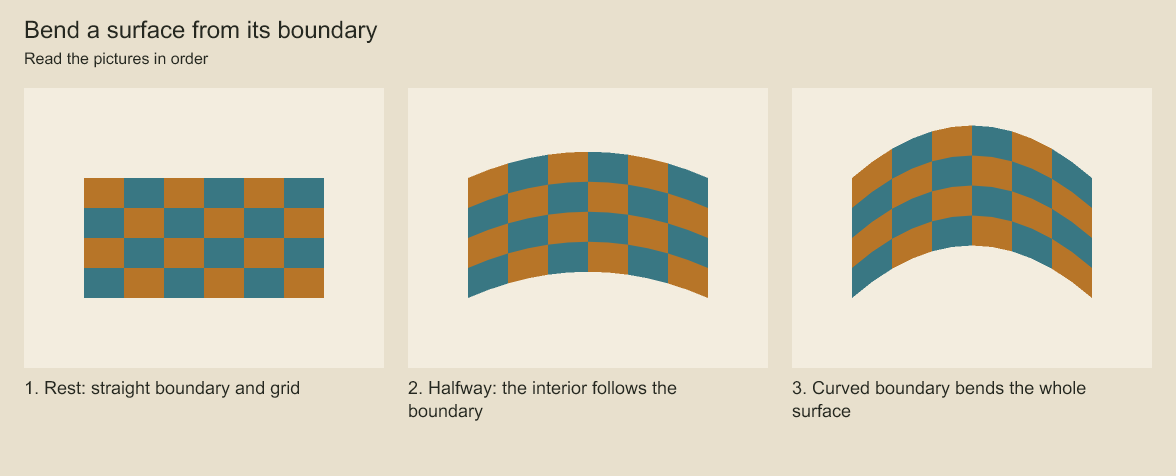
The woven grid follows the curved upper and lower edges. The side endpoints stay fixed. An authored envelope generates a mesh that deforms the interior artwork.
Bake a four-boundary envelope
bakeEnvelopeMesh({ rest, columns, rows, keyframes }) returns a regular indexed mesh track.
Each pose contains four cubic tuples: top, bottom, left, right. Top and bottom run
left-to-right; left and right run top-to-bottom. Their shared endpoints must match exactly.
Keys contain { frame, pose, easing } and use ordered signed local frames.
The baker samples a bilinearly blended Coons patch: it combines opposite boundary blends
and subtracts the bilinear corner blend. Sampled edge vertices retain boundary coordinates.
The grid defaults to 8 columns and 8 rows; subdivisions accept positive integers, with at
most 4096 triangles and 262144 stored positions across rest and keys. Invalid corners reject
with ENVELOPE_CORNERS; collapsed/inverted triangles use the shared mesh diagnostics.
Use the result in layer.mesh, retaining the envelope recipe in authoring source. Interpolation is
between baked vertices; this operation does not persist live envelope controls. It covers
four-boundary patches, not arbitrary closed contour cages, automatic binding or global
intersection prevention.
Persist an editable envelope
Use layer.envelope with { layerId, envelope: recipe } to retain the boundary controls,
rest pose and grid in the shot. envelope: null clears the layer's binding. The recipe is an
EnvelopeMeshInput; it uses the same strict corner, geometry and budget checks as baking.
layer.envelope.key.put accepts a complete { frame, pose, easing } key;
layer.envelope.key.remove requires an existing signed frame. The shared draft owner preserves
rest/grid and other keys, rejects wrong binding types, and validates the final shot.
The renderer prepares vertex keys from the saved controls. A fixed-grid Coons surface is linear in its boundary control coordinates, so interpolation of these prepared positions represents interpolation of the controls with the same easing (subject to floating-point rounding). Unlike a curve ribbon, it has no normalized tangent that must be recalculated. Each evaluated mesh is still checked for degeneracy/foldover; valid endpoints do not prove all in-between frames valid.
Rendering, point mapping and frame vertex inspection share the binding evaluator.
shotMeshData reports bindingKind: 'envelope', envelopeRest, envelopeGrid, and bounded
key pages with boundary poses; the two envelope metadata fields are null for other bindings.
The existing one-binding-per-layer, nested-group composition, lock and mask-boundary rules
apply. Older strict readers reject envelope records.
Codeboard by Nonom Friedman
Explore Nonom Library