OTIO editorial conform
importOTIO maps an OpenTimelineIO cut list to existing shot animations.
exportOTIO writes an editorial sequence as OTIO JSON. Neither function reads
media URLs or embeds artwork. Keep the original OTIO file and the editable
Codeboard project with the exported edit.
import { importOTIO, exportOTIO } from "codeboard-studio";

const media = [
  { animationId: "animation:shot-a", targetUrl: "media/shot-a.mov", sourceStartFrame: 1001 },
  { animationId: "animation:shot-b", targetUrl: "media/shot-b.mov" },
];
const result = importOTIO(otioJSON, project.studio.animations, {
  sequenceId: "edit:main",
  frameRate: { numerator: 24, denominator: 1 },
  media,
  lossPolicy: "report",
});
// Inspect result.losses before applying the conform to the saved project.
const plan = project.plan("Import editorial cuts", [
  { op: "editorial.put", sequence: result.sequence },
]);
await project.commit(plan, { requestId: "conform:revision-1" });
const exported = exportOTIO(result.sequence, project.studio.animations, { media });
Each media URL and animation ID must appear only once in media. Matching is
exact; names and basenames are never inferred. sourceStartFrame specifies the
external media frame corresponding to animation frame zero, at the animation's
rate. Its default is zero. An OTIO available_range, when present, must match
that origin and the mapped animation duration. A mapped animation retains its
artwork, camera, and native audio; the importer changes only the editorial cut list.
Source-in positions convert exactly to animation frames; clip durations convert
exactly to sequence frames. Unrepresentable boundaries fail instead of rounding.
For fractional frame rates, supply the actual rational sequence and animation
rates, such as 24000/1001. Numeric OTIO rates are matched to those supplied
fractions; other rates retain their numeric value.
The adapter accepts Timeline.1 → Stack.1 → one Track.1 of kind Video,
containing Clip.1 or Clip.2 with ExternalReference.1. Export writes Clip.2.
Stable clip IDs round-trip in metadata.codeboard.clipId; third-party clips
without that metadata receive IDs derived from the supplied sequence ID and
clip index. JSON is limited to 1 MiB and the video track to 1000 clips. These
contracts follow the official serialized schema.
lossPolicy defaults to reject. With report, unrepresented names, metadata,
markers, display colors, image bounds, inactive references, timeline origins,
and audio tracks may be omitted. The returned losses list identifies their
paths and reasons; reports above 256 KiB fail. Export reports native shot and
editorial audio separately. Media files may themselves contain sound; the
adapter neither probes nor alters them.
Transitions, gaps, effects/retimes, disabled items, trimmed compositions, nested
or multiple video tracks, and non-external references are rejected even with
report. Error details include the failing object path. Convert unsupported transitions in your editing application before importing.
Rebuild a sequence from a cut list. Which source picture appears at each point in an edit?
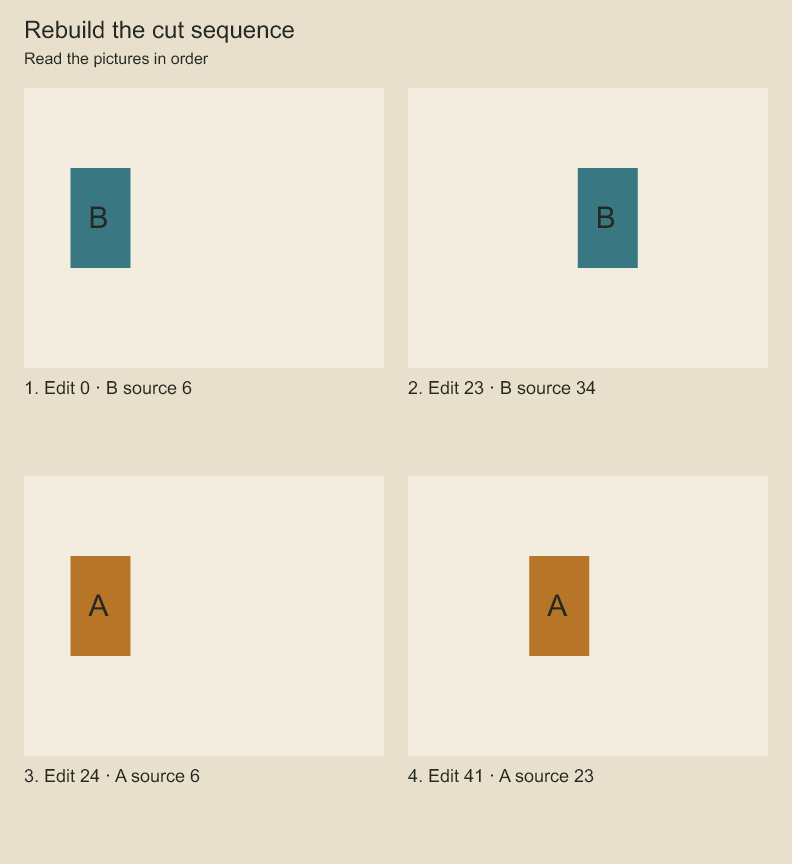
Read the samples in edit order. Each caption identifies the source shot and frame selected by the cut list. The edit maps source ranges onto a timeline, including sources with different frame rates.
Codeboard by Nonom Friedman
Explore Nonom Library