Attach artwork to animated joints
Use skin weights to let several joints influence one mesh. You supply the mesh and weights; inspect bends for collapsed or inverted triangles.
Share a bend between two joints. Which part of the strip follows each joint?
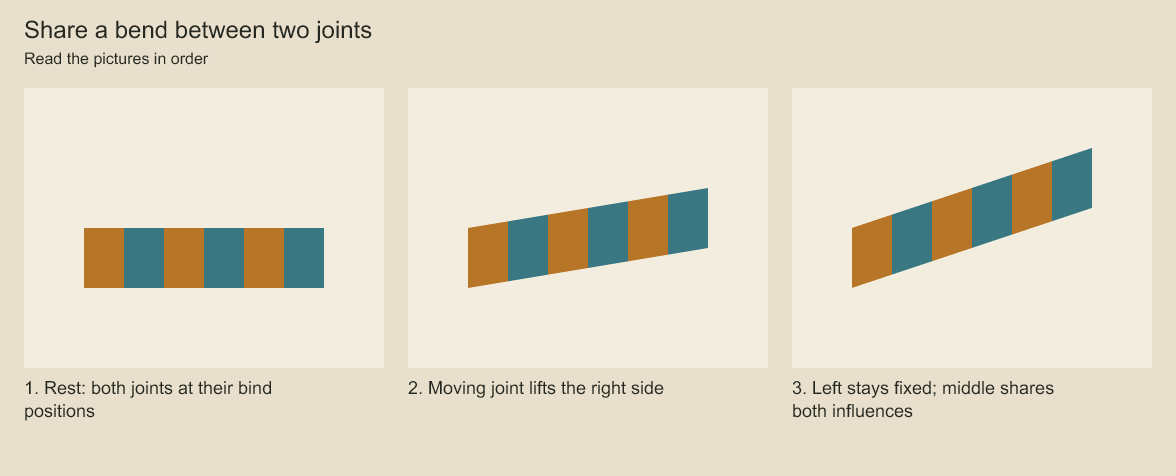
The left edge stays fixed, the right edge rises, and the middle moves halfway. Explicit weights combine joint motion at each mesh vertex. No weights are generated automatically.
Skin vertices with explicit joint weights
createSkinMeshEvaluator({ source, triangles, joints, weights }) snapshots a skin definition
and returns a function accepting joint poses. Each joint is { id, bind }; each pose is
{ jointId, matrix }. Both affine matrices map joint-local coordinates into the mesh's local
space. Each source vertex has 1–8 { jointId, weight } influences. Joint IDs are local to
this definition, not references to project layers.
The evaluator computes pose × inverse(bind) per joint and blends the transformed source
vertex using its weights. It supports at most 256 joints and the existing mesh geometry
limits. Bind matrices must be safely invertible. Every vertex requires distinct existing
joint IDs and positive weights summing to one within 64 machine epsilons; accepted rounding
residue is normalized. Each evaluation must supply every joint exactly once. Invalid bind,
weights or pose references reject with SKIN_* details. The resulting mesh is validated for
finite geometry, degeneracy and winding reversal before return.
The returned source, destination and triangles are detached and use the mesh coordinate
contract. Use destination as a layer.mesh.key.put pose to bake a standalone result,
or use the live layer binding in the next section. Automatic weight generation is not provided; supply weights explicitly. Linear blend skinning can collapse or fold geometry under some poses; those
poses reject rather than silently disabling validation.
Drive a skin from animated layer joints
layer.skin persists LayerSkinInput: the same source, triangles, joints and weights plus
jointLayers: [{ jointId, layerId }]. Map every local joint exactly once to an existing layer
in the same shot. Group layers work as a skeleton hierarchy; animate them with ordinary
layer.pose or layer key edits. Joint bind matrices map joint-local coordinates into mesh-local
coordinates at the intended rest pose. Supply those matrices explicitly or capture them with layer.skin.bind.capture below.
Binding does not overwrite joint keys.
project.editShotAnimation(animationId, [{
  op: 'layer.skin', layerId: meshLayerId,
  skin: {
    source: [{ x: 0, y: 0 }, { x: 100, y: 0 }, { x: 0, y: 100 }],
    triangles: [[0, 1, 2]],
    joints: [{ id: 'root', bind: [1, 0, 0, 1, 0, 0] }],
    weights: Array.from({ length: 3 }, () => [{ jointId: 'root', weight: 1 }]),
    jointLayers: [{ jointId: 'root', layerId: rootJointLayerId }],
  },
}]);
The example bind assumes coincident mesh/joint local spaces at rest. At each requested frame,
the evaluator composes the existing layer transforms and pivots, converts each joint pose into
the mesh's local space, then applies weighted skinning. Camera, depth and visibility do not
change joint poses; skin coordinates are pre-camera. Shared ancestors act after skinning and
cancel from the relative transform, including shared deformed ancestors. A nonshared deformed
ancestor or a joint inside the skinned layer rejects with SKIN_DEFORMATION_BOUNDARY.
Noninvertible mesh-relative transforms reject at evaluation with SKIN_LAYER_TRANSFORM and
joint/frame context. Per-frame mesh validation still rejects collapse or winding reversal.
A layer has one binding: skin replaces its previous mesh/curve/envelope binding. skin: null
clears it. Removing a referenced joint requires clearing or repairing its bindings in the same
edit batch. Foreign layer locks protect owned layer data and bindings; they do not freeze
upstream joint motion. layer.deformation.rest.apply rejects skins with
SKIN_REST_REQUIRES_JOINT_KEYS: restore the actual joint keys explicitly, preserving their
normal IDs and locking semantics.
shotMeshData supports paged joints (bind matrix and mapped layer ID) and weights
(vertex index and influences), also available through mesh-data --kind joints|weights.
Non-skin bindings return empty pages for these collections. Skin keyframes is empty because
animation belongs to its joint layers. Vertex queries without a frame return bind vertices;
frame queries, point mapping and rendering share live evaluation. Pagination and byte limits
are unchanged.
Capture a skin bind pose
project.editShotAnimation(animationId, [{
  op: 'layer.skin.bind.capture', layerId: meshLayerId, frame: 0,
}]);
This replaces each existing skin joint's bind matrix with its evaluated mesh-local transform at the signed local frame. It uses exactly the same hierarchy, pivot and deformation-boundary resolution as live skin evaluation. Existing source vertices, topology, weights, mappings and joint animation keys stay intact. The captured frame becomes the identity skin deformation (up to floating-point precision), relative to the unchanged source vertices. This operation rebinds the animation: other frames can change appearance. It does not bake the current visible deformation into a new source mesh or restore a joint pose.
Use it after creating/moving joint layers, including earlier edits in the same batch. A batch can put a skin with invertible provisional binds and then capture the intended rest frame. Missing/wrong bindings, dangling mappings, deformation crossings and unsafe transform inverses reject. Final shot validation also rejects singular captured joint binds. Capture changes the skin binding owned by the mesh layer, so normal layer locks, transaction rollback, plan CAS and receipts apply. Later joint edits do not silently recapture bind matrices.
Revise skin weights without replacing the binding
project.editShotAnimation(animationId, [{
  op: 'layer.skin.weights.put', layerId: meshLayerId, vertexIndex: 2,
  influences: [
    { jointId: 'tip', weight: 0.6 },
    { jointId: 'root', weight: 0.4 },
  ],
}]);
This replaces the complete influence list for one zero-based source vertex. Each list contains
1–8 distinct existing joints, positive finite weights, and a total of one within the same
rounding tolerance as full skin binding. Omit a joint to remove its influence; zero weights and
empty lists reject. The operation does not normalize arbitrary totals or infer missing weights.
An out-of-range source vertex rejects with SKIN_WEIGHT_VERTEX; a non-skin binding rejects
with MESH_BINDING_KIND.
Use multiple edits in one animation.edit batch to revise several vertices atomically.
Repeated edits to the same vertex follow batch order. Final shot validation checks the resulting
binding before installation; source geometry, topology, bind matrices, joint mappings and
unaddressed weights remain unchanged. Normal layer locks and saved-plan version checks still
apply. Read the paged weights collection to prepare a correction. Vertex indices refer to the
current topology, so use version-pinned saved plans when applying agent corrections.
Live skin pose resolution reuses evaluated local layer transforms and relative path matrices within each frame request. Mesh inverses are shared by joints with the same cancelled ancestor prefix. All such caches are local to that request; bind capture uses the same resolver. There is no previous-frame state or cross-frame geometry cache. Runtime seek parity and production performance still require measurement.
Codeboard by Nonom Friedman
Explore Nonom Library